In football betting communities, there’s a familiar storyline: someone wins a couple of bets in a row, calls it “instinct,” and starts believing they’ve cracked the code. Then reality hits—variance swings back, the streak ends, and the same person blames “bad luck.”
The truth is simpler and less romantic: luck exists, but it’s not a strategy. If you want to analyze odds and picks more seriously, you need something repeatable—something you can measure, improve, and learn from. That’s where data comes in.
If you want to explore match previews, odds context, and data-based insights, you can follow markets and analysis at keo nha cai
Responsible note: Betting involves risk. This article is educational—focused on how statistical thinking improves decision-making, not guaranteeing profits.
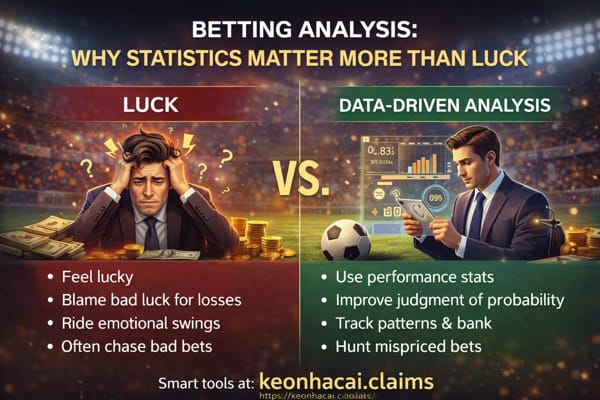
1) Luck wins sometimes. Statistics wins in the long run.
A lucky guess can win any single match. That’s why betting feels exciting: one game can make you feel like a genius.
But betting is not a one-game activity. It’s a long sequence of decisions. Over time, the question becomes:
-
Are you consistently getting good prices?
-
Are your picks beating the market even slightly?
-
Do you understand why you won or lost?
Luck can’t answer those questions. Data can.
When people say “statistics matter more than luck,” they mean this:
data helps you make decisions with positive expected value over a large sample, while luck only explains short-term outcomes.
2) What “data-driven soi kèo” actually means
“Soi kèo” based on data doesn’t mean drowning in spreadsheets or pretending football is a math equation. It means using statistics to support your judgment instead of relying on vibes.
A data-driven approach usually includes:
-
Team performance indicators (not just results)
-
Home/away splits
-
Goals, shots, chances, and efficiency
-
Player availability and lineup impact
-
Scheduling factors (rest days, travel, congestion)
-
Odds movement and market behavior
The goal is to build a more accurate mental model of the match—then compare that model to the price the bookmaker is offering.
3) Results lie. Performance tells the truth.
One of the biggest mistakes in betting is overvaluing recent results.
Example:
-
Team A won 3 matches in a row
-
Team B lost 2 matches in a row
Most casual bettors instantly assume Team A is stronger. But data can reveal a different story:
-
Team A won despite being outplayed, finishing low-quality chances, or benefiting from red cards
-
Team B lost while creating better chances, dominating territory, or missing key players who are now back
Statistics helps you separate:
-
What happened (scoreline)
from -
What’s likely to happen next (underlying performance)
This is where real value often hides—because public betting heavily follows results, not performance.
4) Probability thinking beats “sure bets”
A professional doesn’t ask:
“Will this win?”
They ask:
“What’s the probability, and is the price fair?”
If the odds imply a 50% chance but your research suggests it’s closer to 58%, that’s value—even though the bet can still lose.
That mindset shift is the most important upgrade:
-
You stop hunting “guaranteed” picks
-
You start hunting mispriced probabilities
And that’s why data matters: it helps you estimate probability more realistically.

5) The market is smarter than you think—so you need an edge
Bookmakers don’t set odds based on hope. Odds are shaped by:
-
models
-
sharp bettors
-
public money
-
risk balancing
So if your only “edge” is luck or intuition, the market will punish you eventually.
Data gives you a chance to develop a real edge through:
-
better match interpretation
-
identifying when narratives are misleading
-
spotting overreactions (injury news, hype teams, big-name bias)
-
detecting value early before odds adjust
Platforms like keo nha cai can help you practice this by tracking fixtures, odds context, and match information in a way that’s easier to compare across games.
6) Bankroll control is also a data skill
Even if your analysis is strong, poor bankroll management destroys you.
Data-driven bettors track:
-
bet size consistency
-
win rate over time
-
performance by market type (AH, O/U, 1X2)
-
ROI and variance
-
biggest mistakes and patterns
This tracking turns betting from “emotional swings” into “measurable decisions.”
It also stops the classic trap:
-
win → overconfidence
-
loss → chase
-
bigger loss → tilt
-
collapse
Numbers don’t just analyze matches—they analyze you.
7) A simple data-based workflow you can actually follow
You don’t need a complex model to be more disciplined. A simple workflow is enough:
-
Start with the odds and identify what the market expects
-
Check performance-based indicators (not just recent results)
-
Factor in team news, schedule, and motivation
-
Decide whether the price is fair—or slightly off
-
If you can’t explain your pick in one paragraph, don’t bet
If you want a place to compare match context and pricing, you can use keo nha cai and the main hub keonhacai.claims to keep your analysis consistent.
Final thoughts
Luck will always play a role in football. A red card, a deflection, a missed penalty—these things happen. But over time, luck doesn’t define success. Decision quality does.
Statistics won’t make you win every bet, but it will:
-
reduce emotional betting
-
improve probability judgment
-
help you spot misleading narratives
-
make your strategy consistent
And in betting, consistency is the closest thing to “control” you’ll ever get.
If you want, paste one match you’re considering (teams + odds), and I can show how to build a data-based soi kèo breakdown step by step—without turning it into complicated math.
Related Articles